The Floras
Thanks to several dedicated botanists in the past, we have a few significant publications on the vascular flora of the Quad Cities region. Most prominent of these are the works on the plants of Scott and Muscatine counties in Iowa. This project was initiated at the turn of the 19th century by three botanists, Ferdinand Reppert, William David Barnes, and Alonzo Alexander Miller, who spent ten years collecting plants in these counties. Their efforts culminated in the publishing of “The Flora of Scott and Muscatine Counties” in 1901 which listed the names, frequencies, and habitats of 1,065 taxa believed to be native or naturalized (see below for a pdf of this book).
The project was carried forth by Ludwig F. Guldner in the mid-19th century. Guldner’s decades of work on the Quad Cities flora resulted in the 1960 publication of “Vascular Plants of Scott and Muscatine Counties: With some reference to adjoining areas of surrounding Counties in Iowa and to Rock Island and Whiteside Counties in Illinois. A Regional Flora.” This annotated checklist comprised 1,293 taxa of both spontaneous and cultivated vascular plants collected in the region. Guldner also discussed the natural history, climate, and plant communities of Scott and Muscatine counties in his book.
Another significant contribution to the vascular flora of the region came from Marcus J. Fay who produced “The Flora of Cedar County, Iowa” in 1951. Fay followed this publication with “Additions to the Flora of Cedar County, Iowa” in 1953 with coauthor Robert F. Thorne. With the 1953 update, a total of 802 taxa were reported for the county.
On the Illinois side of the Mississippi, the most significant floristic work came from botanist Raymond J. Dobbs of Geneseo, IL. In 1963, he published “Flora of Henry County, Illinois” which listed 1,288 taxa of vascular plants collected solely by him between 1934 and 1955 (see below for a checklist of taxa from Dobbs’ flora). Like the above mentioned works, Dobbs’ book also took the form of an annotated checklist which provided species names, frequencies, and locations and dates of collection.
These four works together represent the most thorough floristic inventories of our region to date. Several other publications, though of more limited scopes, have covered various aspects of our flora, as well. Some of the most notable include “A Preliminary List of Plants of the Sand Mounds of Muscatine and Louisa Counties, Iowa” by Mabel and Robert Brown (1939) (available here), “The Flora of the Pine Hill Prairie Relic” by Thomas Morrissey (1956) (available here), and “Vegetation and Flora of the Sand Deposits of the Mississippi River Valley in Northwestern Illinois” by Ebinger, Phillippe, Nyboer, McClain, Busemeyer, Robertson, and Levin (2006) (available here).
THE HERBARIA AND COLLECTORS
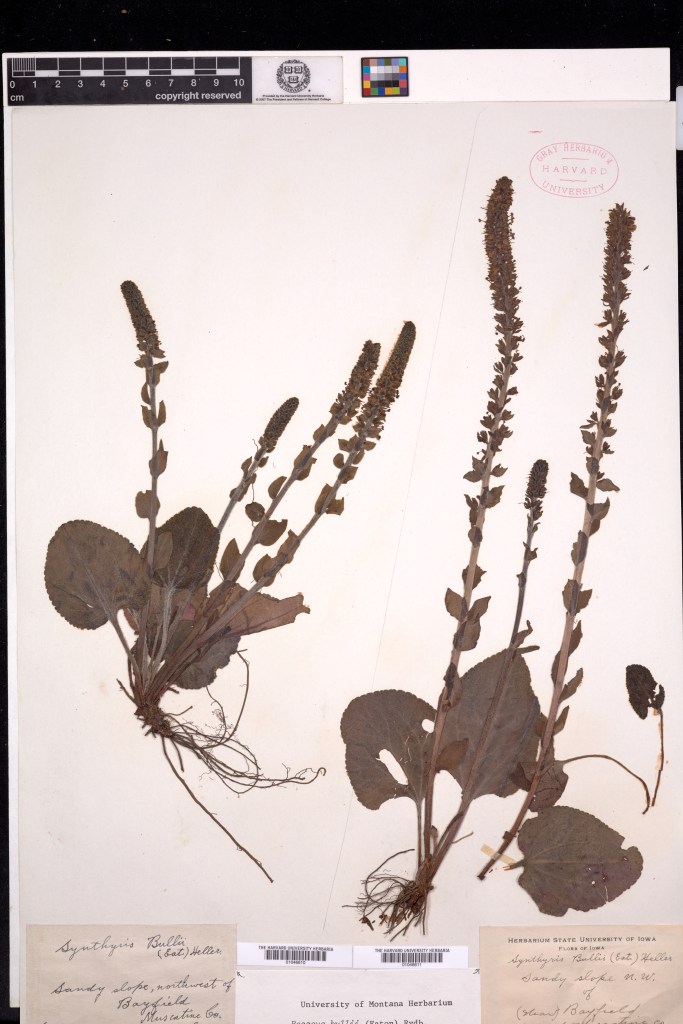
Three herbaria exist in the QC Region which house thousands of specimens collected here. These include the herbaria at Augustana College, the Putnam Museum and Science Center, and Saint Ambrose University. Several other herbaria in Illinois and Iowa also contain significant numbers of specimens collected in the QC Region. These are the herbaria at the Illinois Natural History Survey, Iowa State University, and Western Illinois University. All specimen records from these institutions are available on the Consortium of Midwest Herbaria website.
Many plant collectors have contributed to these herbaria over the years. Several prolific collectors are listed below with their approximate dates of field work (list adapted from Guldner’s “Vascular Plants of Scott and Muscatine Counties”):
- Edith Ross (1878-1888)
- Ferdinand K. Reppert (1878-1900)
- William D. Barnes (1890 – 1900)
- Naomi Melville (1892-?)
- Bohumil K. Shimek (1898-1937)
- J. H. Paarmann and Sarah F. Sheldon (1902-1928)
- Ulrich A. Hauber (1910-1936)
- Raymond J. Dobbs (1934-1955)
- Ludwig F. Guldner (1946-1969)
- Robert A. Evers (1947 – 1976)
- Thomas Morrissey (1950-1961)
- Loy R. Phillippe (1988-1996)
References
Brown, Mabel Estle and Brown, Robert G. (1939). A Preliminary List of Plants of the Sand Mounds of Muscatine and Louisa Counties, Iowa. Proceedings of the Iowa Academy of Science, 46(1), 167-178.
Consortium of Midwest Herbaria. 2023. https://midwestherbaria.org/portal/index.php. Accessed on March 25.
Dobbs, Raymond J. (1963). Flora of Henry County, Illinois. Natural Land Institute.
Ebinger, J. E., Phillippe, L. R., Nÿboer, R. W., McClain, W. E., Busmeyer, D. T., Robinson, K. R., & Levin, G. A. (2006). Vegetation and Flora of the Sand Deposits of the Mississippi River Valley in Northwestern Illinois. Illinois Natural History Survey Bulletin, 37(1-6), 191–238. https://doi.org/10.21900/j.inhs.v37.122
Fay, Marcus J. (1951) “The Flora of Cedar County, Iowa,” Proceedings of the Iowa Academy of Science, 58(1), 107-131. Available at: https://scholarworks.uni.edu/pias/vol58/iss1/11
Fay, M. J. and Thorne, R. F. (1953) “Additions to the Flora of Cedar County, Iowa, “Proceedings of the Iowa Academy of Science: Vol. 60: No. 1 , Article 17. Available at:https://scholarworks.uni.edu/pias/vol60/iss1/17
Guldner, Ludwig F. (1960). Vascular Plants of Scott and Muscatine Counties: With some reference to adjoining areas of surrounding Counties in Iowa and to Rock Island and Whiteside Counties in Illinois. A Regional Flora. Davenport Public Museum.
Reppert, F., Barnes, W., Miller, A. (1901). The Flora of Scott and Muscatine Counties. Davenport Academy of Sciences.
Morrissey, Thomas (1956). The Flora of the Pine Hill Prairie Relict. Proceedings of the Iowa Academy of Science, 63(1), 201-213.
 Flora of the Quad Cities Region